Listen to Adios Ke Aloha on Youtube - http://www.youtube.com/watch?v=k7Dk5H80XqE
E kuʻu belle o ka pō laʻilaʻi
Ka lawe mālie a ka mahina
Kōaniani mai nei e ke ahe
Āhea ʻoe hoʻolono mai
Hui:
Āhea ʻoe, āhea ʻoe
ʻOe hoʻolono mai
I nei leo nahenahe
Adios, adios ke aloha
E ka hauʻoli ʻiniki puʻuwai
E ke aloha e maliu mai ʻoe
Ke hoʻolale mai nei e ke Kiu
Ua anu ka wao i ka ua
Hoʻokahi kiss
Dew drops he maʻū ia
E ka belle o ka noe līhau
Eia au lā e ke aloha
Ke huli hoʻi nei me ka neo
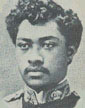
Prince
William Pitt Leleiohoku
- My belle of the clear
night
- When the moon shines in its tranquility
- And a gentle breeze plays
- Oh, when will you listen to me
Chorus:
When, when
Will you listen?
To this gentle plea?
Goodbye, goodbye beloved
O happiness that grips the heart
O beloved hearken to me
The Kiu breeze brings a message
That the forest is made cold by the rain
One kiss
As cool as a dew drop, will do
O belle of the ice cold mist
Here I am, your lover
Returning empty handed - When the moon shines in its tranquility
Source: King's "Songs of Hawaiʻi" -
Written in the 1870's, Leleiohoku was influenced by the
music of the Mexican cowboys or vaqueros. Captain Vancouver
presented a gift of longhorn cattle to King Kamehameha I, at
Kealakekua, in 1793. A 10-year kapu was placed on the cattle
to allow them to multiply and assure the island of a
constant food supply. The wild cattle became a menace and
Kamehameha III, in 1832, invited 3 of Mexico's best cowboys,
(Kossuth, Ramon and Lauzada) to Waimea to teach the
paniola's the art of roping. © 1942 Charles E. King Translated by Mary Pukui, Hawaiian Text edited by Puakea Nogelmeier